
By Andrea Zavatto – Specialist in Foreign Trade and Internationalization Strategy
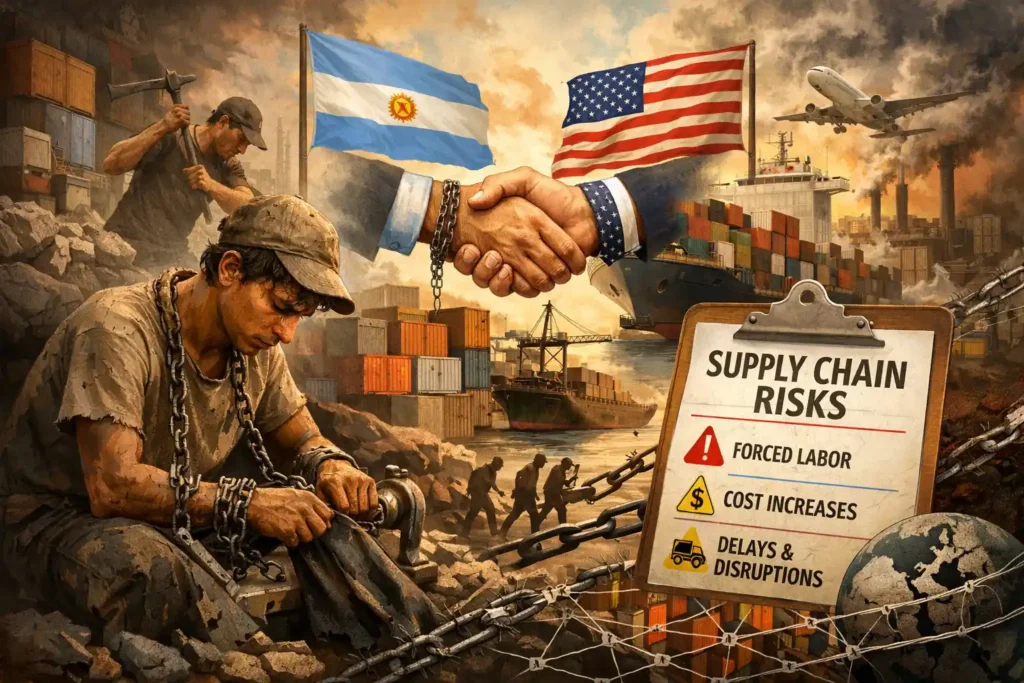
In March 2026, the Office of the United States Trade Representative (USTR) announced the start of investigations into 60 economies—including Argentina—to assess whether they have effective mechanisms to prevent the entry of products made with forced labor into their markets.
While the measure does not target specific sectors or involve immediate sanctions, it sends a clear signal: The United States is raising the standard for access to its market, increasingly incorporating requirements related to how goods are produced, and not just what is exported.
A change in the rules of international trade
This approach isn't entirely new, but it is intensifying. US regulations allow for blocking the entry of products when there are suspicions of forced labor anywhere in the supply chain.
This includes not only the final product, but also inputs, components, or intermediate processes, which significantly expands the scope of the controls.
In practice, this means that a business transaction can be affected even when the problem is not with the direct exporting company, but with a supplier within its supply chain.
Traceability as a new access condition
Herein lies a key change for businesses: the supply chain traceability It ceases to be a reputational aspect and becomes an operational condition for accessing the US market.
This new scenario demands greater visibility into the origin of inputs and the conditions under which they were produced.
A trend aligned with international standards (ESG)
This evolution aligns with a broader agenda that is already impacting international trade: ESG (environmental, social and governance) criteria and the growing demands for transparency in supply chains.
In this context, labor compliance is progressively being integrated as a central element within the strategies of foreign trade.
Specific challenges for Argentine companies
For Argentine companies that export to the United States —or that participate indirectly in value chains destined for that market— this scenario poses concrete challenges:
- Identify the origin of critical inputs
- Evaluate suppliers, even beyond the first level
- Have documentation that supports the production conditions
- Incorporate basic due diligence criteria into your processes
It's not necessarily about immediate major transformations, but rather about starting to organize information that until now was not a priority.
Forced labor as a non-tariff barrier
Another relevant point is that this type of demand functions, in practice, as a non-tariff barrier.
It is no longer enough to comply with tariffs, technical standards, or sanitary requirements: The way in which something is produced is becoming as important as the product itself..
Argentina under analysis: an early sign
Argentina's inclusion in this review should be interpreted as an early warning sign. It doesn't imply a current problem, but it does foreshadow the direction in which international trade is heading.
Conclusion: anticipation as a competitive advantage
In this scenario, companies that anticipate changes—even gradually—will be better positioned not only to reduce operational risks, but also to sustain and strengthen their business relationships in increasingly demanding markets such as the United States.
At MJE Comercio Exterior, we advise companies on adapting their operations to international compliance standards, including supply chain traceability and preventing regulatory risks in exports to the United States.
📩 Contact us to assess the impact on your operations and anticipate new demands of international trade.
Andrea Zavatto She is an Argentine lawyer specializing in foreign trade and internationalization strategy. She advises companies in Argentina and the United States. She is a member of the Argentine Association of Fiscal Studies, the Argentine Institute of Customs Studies, and the Customs and International Trade Bar Association (CITBA).